
What Makes a Great Startup Website? Design Principles That Drive Growth
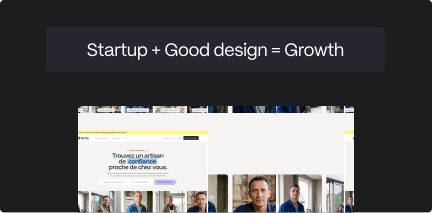
Most startup websites fail at the same thing: they describe the product instead of selling the outcome. This guide covers the design principles that separate a startup website that generates traction from one that just exists. Structure, hierarchy, trust signals, performance, and the decisions that actually move the needle at the early stage.
Most startup websites have the same problem. They describe the product instead of selling the outcome. They explain how the thing works before the visitor understands why they should care. They bury the value proposition under a header image that looks good in Figma and says nothing in practice.
A great startup website doesn't require a big budget or a famous web design studio. It requires clarity, structure, and a few decisions made in the right order. This guide covers the principles that consistently separate websites that generate traction from websites that just exist.
Visuweb specializes in startup website design for businesses at various stages, from pre-launch to Series A. The principles in this article are drawn from what actually works across those projects, not from design award winners.
Why Startup Websites Fail More Often Than They Should
The failure mode is almost always the same: the founders understand the product deeply and write for themselves. They use internal vocabulary, assume familiarity with the problem space, and optimize for being accurate rather than being understood. This happens in every type of business, from SaaS to services, and it costs significantly in conversion.
The visitor arrives knowing nothing about the company. They spend three seconds trying to understand what the product does. If they can't, they leave. The bounce rate is high, the conversion rate is low, and the team assumes it's a traffic problem when it's actually a clarity problem.
The second failure mode is visual: the site looks like a template. Clean, inoffensive, forgettable. It communicates nothing about the brand personality, the stage of the company, or the target audience they're trying to attract. In a world where investors and potential customers make decisions based on instinct and pattern recognition, a generic site that isn't on brand is a signal that nothing interesting is happening here.
Both problems are design problems. Both are solvable.
The First 5 Seconds: Value Proposition and Hero Section
The hero section of a startup website has one job: make the visitor understand what you do and why it matters in under five seconds. Everything else is secondary.
A strong hero section has three elements: a headline that states the outcome, a sub-line that adds specificity, and a primary CTA that creates a next step.
The headline should not describe the product. It should describe the result the customer gets. "The project management tool for remote teams" describes the product. "Your team ships faster when everyone knows what's next" describes the outcome. The second version creates a reaction. The first creates a category.
The sub-line earns the headline. It adds one layer of specificity: who it's for, how it works at a high level, or what makes it different. Two sentences maximum.
The CTA should reflect where the visitor is in their journey. For a pre-launch product, "Join the waitlist" is honest and creates urgency. For a live product, "Start free" or "Book a demo" depending on the model. Avoid vague CTAs like "Learn more", they create no commitment and no momentum.
Visual Hierarchy: Guiding the Eye Before the Mind
Visual hierarchy is the order in which a visitor processes information on a page. It's one of the foundations of good web design. A well-structured startup website controls that order deliberately. A poorly structured one leaves it to chance, which means important information gets missed.
Three tools control visual hierarchy: size, contrast, and spacing.
Size establishes importance. The headline is the largest element because it carries the most important message. Supporting elements scale down accordingly. If everything is the same size, nothing is important.
Contrast creates attention. A high-contrast CTA button stands out because it breaks the surrounding visual pattern. A section heading in a different weight or color draws the eye. The color palette should be deliberate: each color in the scheme serves a role, and contrast should be distributed intentionally, not equally across the page.
White space creates breathing room and separates distinct ideas. Crowded layouts make pages feel overwhelming and hard to scan. Generous negative space makes content feel confident and easy to process. A well-established design system handles these decisions consistently, keeping the site user friendly across every page and device. For startups, this is often counterintuitive: it feels like you're wasting space. You're not. You're making the space you use more effective.
For reference on how visual hierarchy is being applied in high-performing sites right now, our article on web design trends in 2026 covers what's actually working.
The Problem-Solution Structure: The Most Reliable Page Architecture
The most reliable page structure for a startup website is problem-solution. It mirrors the mental journey of the ideal customer.
Section 1 (Hero): State the outcome the product delivers. Section 2 (Problem): Name the pain the visitor recognizes. Make them feel understood. Section 3 (Solution): Show how the product solves that specific pain. Section 4 (How it works): Three to five steps or features, concisely explained. Section 5 (Trust): Testimonials, logos, case studies, metrics. Section 6 (CTA): Return to the primary action with a clear next step.
This structure works because it creates a narrative. The visitor arrives with a problem (whether they've articulated it or not), the page names that problem, offers a solution, proves it works, and asks for the conversion. Each section presents key information at exactly the moment the visitor is ready to receive it. Each section earns the next.
Deviating from this structure is fine if there's a reason. Jumping straight from hero to features with no problem framing loses the emotional connection that makes conversion more likely.
Trust Signals: Building Credibility with Potential Customers
Startups have a trust deficit by default. Nobody knows who you are. The website's job is to resolve that deficit fast.
Trust signals fall into four categories:
Social proof is the most powerful: logos of recognizable clients or investors, testimonials with names and job titles (not anonymous), case studies with specific results, press mentions, review platform ratings. Any evidence that someone else has taken the risk and found it worthwhile. The benefit of even one recognizable logo or a single specific metric is significant: it shifts the visitor from skeptic to interested prospect. Startups that sell services or SaaS products should prioritize this section early.
Team credibility matters more at the early stage than most founders expect. A real team page with photos, names, and one-line backgrounds answers the "who am I trusting with this?" question. Anonymous startups convert worse than identified ones. A strong digital presence across social media platforms, including a LinkedIn profile that matches the site's messaging, reinforces credibility significantly.
Specificity signals competence. Vague claims ("we help companies grow faster") are untrustworthy. Specific claims backed by real data ("our median customer sees a 34% reduction in time-to-hire within 60 days") are trustworthy because they're falsifiable. The more specific and data-driven you can be, the more credible you are.
Design quality itself is a trust signal. A site that looks unfinished, inconsistent, or templated signals that the company behind it may operate the same way. A site that feels considered, creative, and complete signals execution capability. Small details matter: a valid SSL certificate, a live demo or interactive preview, and technology that clearly functions as described all contribute to that first impression of credibility. After launch, fine tune the design based on actual user behavior rather than assumptions.
Performance Is a Design Decision
Page speed is not a developer problem. It's a design decision. Every large image, every animation, every third-party script is a choice that affects load time and, by extension, conversion rate.
For startup websites, the performance bar is higher than it used to be. Google's Core Web Vitals are a ranking factor. More importantly, a slow site creates a negative first impression before a single word is read. A visitor who waits three seconds for a hero section to load is already less receptive to whatever message that hero section carries. This applies equally to feature pages, pricing pages, and every other page in the site.
Practical performance decisions that matter at the design stage: image compression and format (WebP, not JPEG by default), limiting animation to meaningful interactions rather than ambient motion, deferring third-party scripts (chat widgets, analytics, tracking pixels) to load after the critical content, and choosing a platform that outputs clean code. Every app integration or added functionality should be evaluated against the load cost it introduces.
Our Webflow design and development approach prioritizes Core Web Vitals from the first build. For a full breakdown of the technical SEO layer, our guide on Webflow SEO best practices covers the implementation.
Mobile-First Is Not Optional
More than half of startup website traffic arrives on mobile, often significantly more for consumer-facing products. A site designed for desktop first and "made responsive" second is a site that provides a worse experience for more than half its visitors.
Mobile-first design means making content hierarchy decisions for the smallest screen, then scaling up. It means CTAs are thumb-reachable. The navigation bar doesn't require precision tapping. Text is legible without zooming. Forms are short enough to complete on a phone without frustration.
The mobile version of your site is not a simplified version of the full-screen experience. It's the primary version for a majority of users.
Key Features and Startup-Specific Considerations
Beyond the universal design principles, startups have specific constraints and opportunities that affect how a website should be built.
Speed to launch matters. An imperfect site that's live beats a perfect site in a three-month Figma file. The first version should be built to test, not to last. Focus on the key features of each core page: the homepage, an about page, a pricing or landing page, and a CTA. Add complexity as data and user behavior reveal what visitors actually need.
The site needs to evolve without a developer. Startups update their messaging constantly as they find product-market fit. A site that requires a dev to change the homepage headline is a liability. Build on a centralized platform with a CMS that allows seamless integration of new content, and lets the founding team make copy changes autonomously.
Investors will visit the site. At the early stage, the website is due diligence material. It signals whether the team can execute on communication and positioning, not just product. Potential customers and investors often make their first judgment about the company from this page alone. A site that would embarrass a founder in a pitch meeting is a problem.
SEO is worth starting early. The compounding value of SEO means the sooner you start, the better. Even for pre-revenue startups, publishing two articles a month on relevant topics costs very little and builds domain authority that pays off six to twelve months later. The concept is simple: every internal link and piece of relevant content you publish today is an asset that grows in value over time. Our article on GEO vs SEO covers why AI search visibility is increasingly part of this equation in 2026.
What the Best Startup Websites Look Like
Rather than pointing to specific examples (which date quickly), here are the characteristics that consistently appear in the best startup websites. These traits show up across industries, whether the startup sells software, services, or physical products, and whether the site is a simple landing page or a multi-page ecommerce experience.
One clear message per section. No section tries to communicate more than one idea. Each section earns a scroll to the next.
Design that feels intentional. Color choices, typography, spacing: everything looks like someone made a decision. High quality visuals and a consistent aesthetic make the site feel credible before a single word is read. Nothing looks like a default.
Copy that addresses the reader directly. "You" more than "we." Problem-first, outcome-focused. No jargon that the ideal customer wouldn't use themselves.
Friction-free conversion flow. The path from landing to taking the desired action has no unnecessary steps. Forms ask for only what's needed. Clear calls to action are placed where the user is ready to act, not just where they're visible.
Proof that the product works. At least one specific, credible piece of evidence that real people have used this and found it valuable. A site that actually performs doesn't just claim results. It shows them.
For startups at the early stage, our For Startups page covers how Visuweb approaches these projects specifically, and the pricing and scope that make sense at that stage. If you want a direct conversation about where your current site is falling short, reach out and we'll give you honest feedback within 24 hours.
FAQ
What makes a good, visually appealing startup website?
A good startup website communicates the value proposition clearly in the first five seconds, builds trust through social proof and specific claims, converts visitors through a clear CTA and friction-free flow, and performs fast on mobile. The most common failure is over-explaining the product before the visitor understands why they should care. A few practical tips: write the headline last, test on a real phone before launch, and have someone outside the team read the homepage cold.
How much does a startup website cost?
A startup website built on Webflow by an agency typically costs between $5,000 and $15,000 for a core marketing site of five to ten pages. Pre-launch one-pagers can be built for less. More complex sites with custom CMS, animations, and multiple page types scale accordingly. For a full breakdown, our guide on how much a startup website costs covers the full range.
What pages does a startup website need?
The minimum viable startup site needs a homepage, an about page, and a contact or CTA page. For SaaS products, a pricing page is essential. For services businesses, a detailed services page is equally critical for explaining what you offer and who it's for. For investor-facing sites, a team page matters. Blog and resources sections are optional at launch but worth building early for SEO. Good web design at this stage means making architecture decisions based on your actual conversion data, not on what other startup websites happen to include.
Should I build my startup website on Webflow?
Webflow is a strong choice for startup websites because it combines web design flexibility with marketing team autonomy. Once the site is built, founders and marketers can update copy, add pages, and manage blog content without technical involvement. It also produces clean, fast code with strong SEO fundamentals. The main alternative for startups is Framer, which has a lower barrier to entry but less content management capability. For any business serious about long-term growth, choosing a platform that doesn't require coding skills for day-to-day updates is worth prioritizing from the start. For a full comparison, see our article on Webflow vs WordPress or our Webflow vs Framer guide.
How long does it take to build a startup website?
A focused startup website of five to eight pages built on Webflow typically takes four to six weeks from kickoff to launch, including design, development, content, and QA. The most common cause of delays is content readiness: copy that isn't finalized and images that aren't delivered slow every other stage. If you come to a project with finalized copy and a clear brief, timelines compress significantly.
What is the most important page on a startup website?
The homepage. It receives the most traffic, carries the most weight for brand perception, and is the page investors, customers, and press visit first. If the homepage doesn't communicate the core message clearly and create a path to conversion, nothing else on the site compensates for that failure. Get the homepage right before optimizing anything else.
How do I make my startup landing page and website convert better?
The highest-leverage changes for conversion are: rewriting the hero headline to focus on outcome rather than product description, adding specific social proof (real names, real numbers), reducing form fields to the minimum required, making the primary CTA visually distinct and verb-forward ("Start free" rather than "Get started"), and improving page load speed. For any business, let data guide the next iteration: A/B test headline variants and CTA copy, then use the results to reveal what's actually driving conversion.
Should a startup website have a blog?
Yes, but not at the expense of the core pages. A blog that's started early and published consistently compounds in SEO value over twelve to eighteen months. The first few articles should target long-tail keywords with low competition and high relevance to the ideal customer's search behavior. Two well-researched articles per month outperforms ten thin articles. Covering topics around web design decisions, business growth, and the specific pain points your product solves is more effective than writing about trends for their own sake. For how to think about content strategy alongside search visibility, our article on GEO vs SEO is worth reading first.
Do I need a web design agency or design studio to build my startup website?
Not necessarily. If you have design skills and time, Webflow or Framer can be learned and used to build a credible early-stage site. The case for working with an agency or design studio is: design quality matters more than most founders admit, and the opportunity cost of founder time on website design is significant at the early stage. An agency that understands startup positioning can compress the timeline to a site that actually converts. Our article on what a Webflow agency does covers how to evaluate whether it's the right decision.
What design mistakes keep startups from building a successful startup website?
The most common mistakes: leading with features instead of outcomes, using vague copy that could apply to any company in the category, neglecting mobile experience, launching with no credibility signals, building a site that can't be updated without technical help, and optimizing for aesthetics over clarity. Successful startups treat their website as a sales tool first and a design showcase second. The most ironic mistake: a site that wins design awards but doesn't convert is a failed project.
Work with Visuweb
We help SMEs, startups, and agencies build brands people remember and websites that actually bring in business.


.avif)